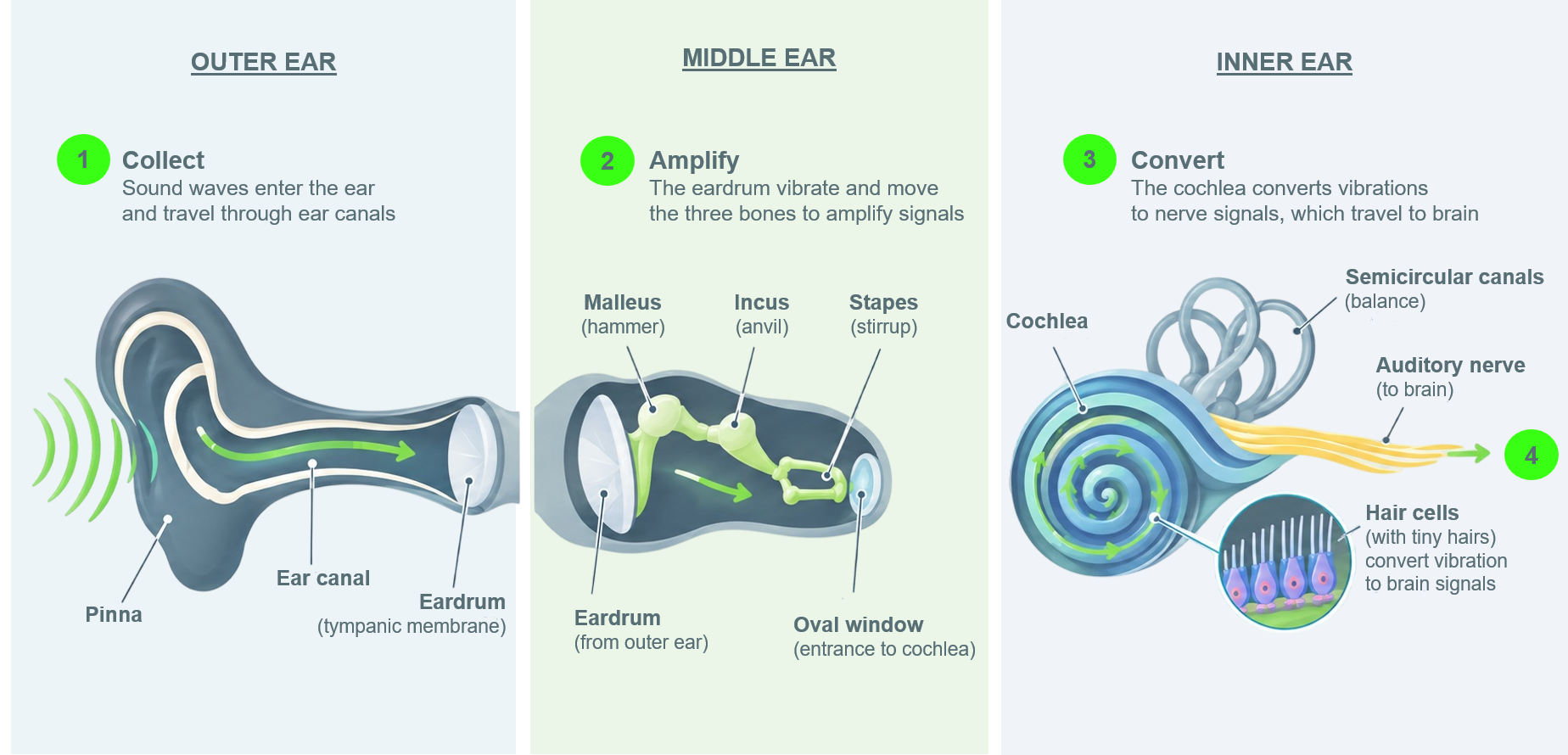
Hearing is a mechanical chain from air to brain. When any link weakens, sounds lose clarity long before they seem to lose volume — which is why hearing loss is so often missed, and so often misunderstood. Most sensorineural hearing loss is the result of damaged cochlear hair cells, and is frequency-specific.
Anatomy of Human Ear
1Sound waves push the eardrum; 2the tiny bones of the middle ear amplify that motion into the fluid-filled cochlea; 3and the basilar membrane within the cochlea ripples in response. As the membrane ripples, it bends the hair cells' stereocilia, 4turning vibration into the nerve signals the brain reads as sound. The basilar membrane is tonotopically organized: stiff and narrow at the base (high frequencies), wide and floppy at the apex (low frequencies). Each frequency has an address — damage to a region of hair cells removes exactly those frequencies from perception. Hair cells do not regenerate. Noise, aging, and disease that damage them are the root of most permanent hearing loss. The high-frequency hair cells work the hardest and are usually the first to go as we age.
The numbers behind human ears
20 Hz–20 kHzHuman hearing range at youth; the usable speech band sits well inside it.
~3,500Inner hair cells — the ear's microphones. They carry ~95% of the signal to the brain.
~12,000Outer hair cells — the ear's amplifier, sharpening quiet sounds before they reach the inner cells.
~4 kHzUpper limit of neural phase-locking — above this, the brain relies on place, not timing.
Common causes of hearing loss — why uniform amplification across frequencies fails
Four patterns cover most of the hearing-loss population — lower on each chart means greater loss. Each frequency region needs its own gain, matched to the loss at that address.
Presbycusis ~60%
Age-related · sensorineural
Gradual, symmetric loss from cumulative wear on the cochlea — progressively worse toward the high frequencies. The most common pattern by far.
Compensation
Noise-Induced ~17%
Sensorineural
Repeated exposure to loud sound damages cochlear hair cells — the classic "notch" around 4 kHz, with some recovery at 8 kHz.
Protect + Compensate
Otosclerosis ~1%
Conductive
Abnormal bone growth fixes the stapes, blocking conduction (lime dashed line: bone conduction stays near-normal).
Surgical + Compensation
Ménière's ~0.5%
Sensorineural · fluctuating
Inner-ear fluid imbalance causes fluctuating, low-frequency loss, often with vertigo and tinnitus — the rarest pattern here.
Medical management
Prevalence figures are approximate shares of the hearing-loss population (synthesized across WHO, NIH/NIDCD, StatPearls and Merck Manual). Clinically, these map onto three mechanism types: conductive (otosclerosis), sensorineural (presbycusis, noise-induced, Ménière's), and mixed — and roughly 77% of all hearing loss is sensorineural with a high-frequency sloping pattern, exactly what a frequency-precise fit like Audile's is built to correct.
Hearing loss recruits loudness faster — why loudness control is important.
Hearing loss doesn't simply turn the world down. In cochlear (sensorineural) hearing loss, loudness grows abnormally fast as sound gets stronger: very soft sounds stay inaudible, but once a sound crosses the elevated threshold, it becomes loud in a hurry — until, at high levels, it feels as loud as it does to anyone else[1]. That phenomenon is called loudness recruitment, and it's the reason "just turning up the volume" so often ends with someone wincing and saying "stop yelling — I hear you just fine."
Loudness–intensity functions (schematic example)
Example: a moderate cochlear loss with a ~60 dB threshold. The normal ear's comfortable window spans roughly 0–100 dB; the window of an ear with hearing loss collapses to a fraction of that, and loudness rises steeply inside it.
Why it happens— the cochlea's lost compressor
Outer hair cells act as the cochlea's active amplifier: using the motor protein prestin, they change length thousands of times per second to boost soft sounds far more than loud ones, giving the healthy ear its built-in compression and sharp tuning.[3]Outer hair cell stereocilia are embedded in the tectorial membrane and absorb the brunt of every vibration of the cochlear partition — the first row is typically hit hardest, so outer hair cells are usually the first to go. When they're damaged, low-level amplification vanishes while the response to high-level sound is largely unchanged — so the cochlea's input–output function steepens, and loudness recruitment appears.[1]
Sources: [1] Shi L, Liu K, Wang H, et al. "A Review of the Neurobiological Mechanisms that Distinguish Between Loudness Recruitment and Hyperacusis." Med Sci Monit (2022). pmc.ncbi.nlm.nih.gov/articles/PMC9006468 · [2] Moore BCJ, "What Is Temporal Fine Structure and Why Is It Important?" J Korean Acad Audiol (2014) — cochlear compression, reduced dynamic range, and WDRC. ncbi.nlm.nih.gov/pmc/articles/PMC4003734 · [3] "Prestin Regulation and Function in Residual Outer Hair Cells after Noise-Induced Hearing Loss." PLoS ONE (2013). journals.plos.org/plosone/article?id=10.1371/journal.pone.0082602
Every scene has its own sound wave — why one fixed amplification curve can't fit all
The long-term energy of real scenes looks nothing alike — speech concentrates in one band, a park peaks where birdsong lives, music is broad and flat. In each chart, the lime band tracks where that scene concentrates its key content — a different region every time, which is why one fixed curve can't fit all.
Clean speech
Energy rolls off above 1 kHz — but the consonants that carry meaning live exactly up there.
Speech in babble
Competing voices fill the same band as the voice you want — the hardest everyday scene.
Nature
Birdsong and ambience peak around 3–5 kHz — a region often lost first in hearing loss.
Music
Broad, flat energy across the whole range — the most demanding scene for a safe, precise fit.
Audile™ is built to solve all of these limitations — its algorithms adapt the fit to each ear and each scene automatically.